
Kolkata Travel Guide
India's cultural soul — where Rabindranath Tagore wrote poetry, where Victoria Memorial stands in white marble splendour, and where Durga Puja transforms the city into the world's greatest open-air festival. Our expert editors curate the finest heritage hotels, cultural experiences, and luxury secrets for visiting Kolkata, West Bengal — updated for 2026.
Expert Kolkata Guides
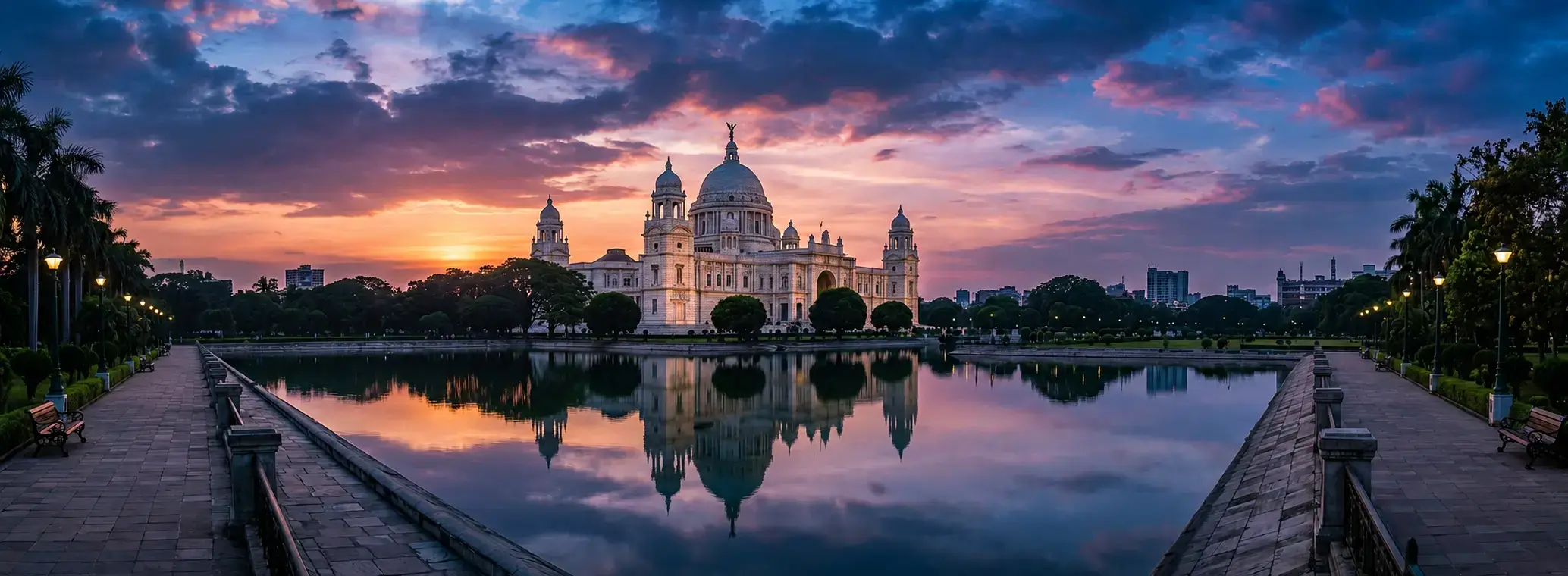
The Best Tourist Places to Visit in Kolkata, India
Discover Kolkata's most extraordinary cultural landmarks — from the Victoria Memorial and Howrah Bridge to the Marble Palace, Kumartuli's sculpting quarter, Park Street's legendary dining, and the city that gave the world Rabindranath Tagore.
Kolkata at a Glance
Kolkata is the cultural capital of India — a city where the weight of history, the depth of intellectual tradition, and the warmth of Bengali hospitality combine into an experience that no other Indian city can replicate. At its heart stands the Victoria Memorial (1906–1921), a vast palace of white Makrana marble set within 64 acres of ornamental gardens — the finest building of the British Raj and today a museum housing 28,000 artefacts of colonial India. The Howrah Bridge (Rabindra Setu), the great 705-metre cantilever completed in 1943 without a single nut or bolt, carries over 100,000 vehicles and pedestrians daily — most spectacularly at dawn, when flower-sellers cross with marigold garlands destined for the Hooghly River ghats. Kolkata is the city of Rabindranath Tagore (1861–1941) — Nobel Laureate in Literature (1913), the first Asian to receive the prize — whose ancestral home at Jorasanko Thakur Bari in North Kolkata remains a place of quiet pilgrimage. The city's luxury heritage stays are extraordinary: The Oberoi Grand on Jawaharlal Nehru Road (formerly Chowringhee), its white colonial façade unchanged since the 1880s and its Captain's Bar among the finest hotel bars in Asia; ITC Royal Bengal with its celebrated Dum Pukht dining experience; and The LaLiT Great Eastern Kolkata, one of Asia's oldest continuously operated hotels (est. 1840), where every corridor carries the scent of empire. Each October, the city undergoes a breathtaking transformation for Durga Puja — recognised by UNESCO as an Intangible Cultural Heritage of Humanity in 2021 — when over 2,500 elaborately designed pandals rise across every neighbourhood, and Kumartuli's master artisans reveal the clay idols they have been sculpting since the previous winter. The Indian Museum (1814) — the oldest in Asia — the Marble Palace mansion with its European masters and curious menagerie, the literary coffeehouses of College Street, the Park Street promenade with its colonial-era restaurants: Kolkata is, above all, a city that rewards those who walk slowly, eat well, and listen.
Frequently Asked Questions
Everything you need to know before visiting Kolkata, India
-
The best time to visit Kolkata is from October to February, when the weather is cool, dry, and clear, with temperatures between 15–25°C. October and November are particularly extraordinary: Durga Puja (UNESCO Intangible Cultural Heritage of Humanity, 2021) transforms the entire city into a spectacular open-air festival of light, art, and Bengali culture. December and January are ideal for heritage walks and outdoor dining on Park Street. Avoid March to June (extreme heat, 40°C+) and July to September (heavy monsoon rains, though the city has its own poetic beauty in the rains). For luxury travellers, the October–November Puja window is the single most unmissable time to visit.
-
Kolkata's finest luxury hotels include: The Oberoi Grand, Kolkata — a magnificent 1880s colonial grande dame on Jawaharlal Nehru Road with white colonnaded façade, 209 rooms, and the legendary Captain's Bar (one of the finest hotel bars in Asia); ITC Royal Bengal — a bold five-star property with multiple restaurants and the renowned Dum Pukht dining experience; Taj Bengal, Alipore — a five-star hotel in the city's most prestigious residential neighbourhood with lush gardens; The LaLiT Great Eastern Kolkata (established 1840) — one of the oldest operational hotels in Asia and a genuine heritage landmark; and JW Marriott Kolkata, the city's newest international luxury address. For the quintessential Kolkata experience, The Oberoi Grand remains the definitive choice for luxury travellers.
-
Kolkata is the cultural capital of India, internationally celebrated for its extraordinary intellectual, artistic, and literary heritage. It is the home of Nobel Laureate Rabindranath Tagore (Nobel Prize for Literature, 1913 — the first Asian recipient). Kolkata is famous for: the Victoria Memorial (1921) — a magnificent white Makrana marble palace and museum, the finest Indo-Saracenic building in India; Howrah Bridge (Rabindra Setu, 1943) — a 705-metre cantilever bridge and one of the world's busiest river crossings; Durga Puja — a UNESCO Intangible Cultural Heritage festival in October/November; the Indian Museum (1814 — the oldest in Asia); Kumartuli, where artisans craft clay idols; Park Street (India's most storied dining promenade); and the Marble Palace mansion with its European art collection.
-
Kolkata is served by Netaji Subhas Chandra Bose International Airport (CCU), 17 km from the city centre. Direct international flights connect from London (~10 hrs via Air India), Dubai (~5 hrs), Singapore (~4 hrs), Bangkok, and Doha. Domestic connections are frequent from Delhi (~2 hrs), Mumbai (~2.5 hrs), Chennai, and Bengaluru. The airport metro link (Blue Line) reaches Esplanade (city centre) in approximately 35 minutes. Hotel transfers and app-based cabs (Ola, Uber) are readily available. Howrah Junction, India's busiest rail terminus, serves the Vande Bharat Express from Delhi and Rajdhani Express services from Mumbai and Chennai.
-
The Victoria Memorial is Kolkata's most iconic landmark — a vast, pristine white marble palace and museum built between 1906 and 1921 in memory of Queen Victoria, Empress of India. Designed by Sir William Emerson in the Indo-Saracenic style and constructed from Makrana marble (the same stone as the Taj Mahal), the Memorial stands within 64 acres of ornamental gardens at the south end of the Maidan. The building is crowned by a 16-foot rotating bronze Angel of Victory. Inside, 25 galleries house over 28,000 artefacts from the British colonial period — paintings, sculptures, maps, manuscripts, and personal artefacts of Queen Victoria. The evening light-and-sound show is among the finest in India. Open Tuesday to Sunday; entry INR 200 (gardens) and INR 500 (museum) for international visitors.
-
Durga Puja is Kolkata's greatest cultural event — a 5-day festival in October or November celebrating the goddess Durga's victory over the demon Mahishasura. In 2021, UNESCO designated Kolkata's Durga Puja as an Intangible Cultural Heritage of Humanity. During Puja, over 2,500 elaborately designed pandals (temporary temples) rise across the city, each housing a commissioned clay idol of Durga crafted by master artisans from Kumartuli. The pandals range from intimate neighbourhood shrines to enormous artistic installations designed by leading architects. The city is illuminated by millions of lights, cultural performances fill every neighbourhood, and Kolkata's legendary street food is at its most vibrant. For luxury travellers, many five-star hotels offer curated Puja tours, heritage walks, and rooftop viewing experiences — book at least 6 months in advance for this period.
-
Kolkata's finest experiences: a dawn walk across Howrah Bridge as flower-sellers cross with marigold garlands; exploring the Victoria Memorial gardens and museum; a private guided visit to the Marble Palace (1835 — 19th-century mansion with European Old Masters and Bengal tigers); visiting Kumartuli to watch master sculptors craft Durga Puja idols; heritage afternoon tea at The Oberoi Grand followed by cocktails at the Captain's Bar; the Indian Coffee House on College Street (since 1942 — where Satyajit Ray and Tagore's circle debated over adda); a sunset Hooghly River cruise past the Dakshineswar Kali Temple; Park Street dining (Mocambo, Peter Cat, Flury's tearoom); a day trip to the Sundarbans; and Jorasanko Thakur Bari — Rabindranath Tagore's ancestral home, now a museum.
-
The best day trips from Kolkata: the Sundarbans (2–3 hrs) — a UNESCO World Heritage mangrove delta, home to the Bengal tiger and Irrawaddy dolphin, best explored by private luxury launch on overnight or full-day safaris; Bishnupur (3.5 hrs) — a UNESCO-tentative site famous for terracotta temples and Baluchari silk weaving; Shantiniketan (3 hrs by train) — Rabindranath Tagore's ashram and university, centre of Baul music and Tagore's educational vision; the Hooghly District colonial towns (1–2 hrs) including Serampore (Danish), Chandannagar (French), and Bandel (Portuguese), each with distinct European heritage churches; and Dakshineswar Kali Temple + Belur Math (45 min) — twin riverside pilgrimage sites north of the city on the Hooghly.