
Lucerne Travel Guide
Switzerland's most romantic city, where the medieval Kapellbrücke spans the Reuss and snow-capped peaks ring a crystalline lake. Our expert editors curate the finest hotels, restaurants, excursions, and insider secrets for visiting Lucerne (Luzern), Switzerland — updated continuously for 2025 & 2026.
Expert Lucerne Guides
The Best Tourist Places to Visit in Lucerne, Switzerland
Discover Lucerne's most iconic attractions — from the medieval Kapellbrücke and Lion Monument to the shores of Lake Lucerne, the summit of Mount Pilatus, and the historic Old Town's winding painted façades.
Lucerne at a Glance
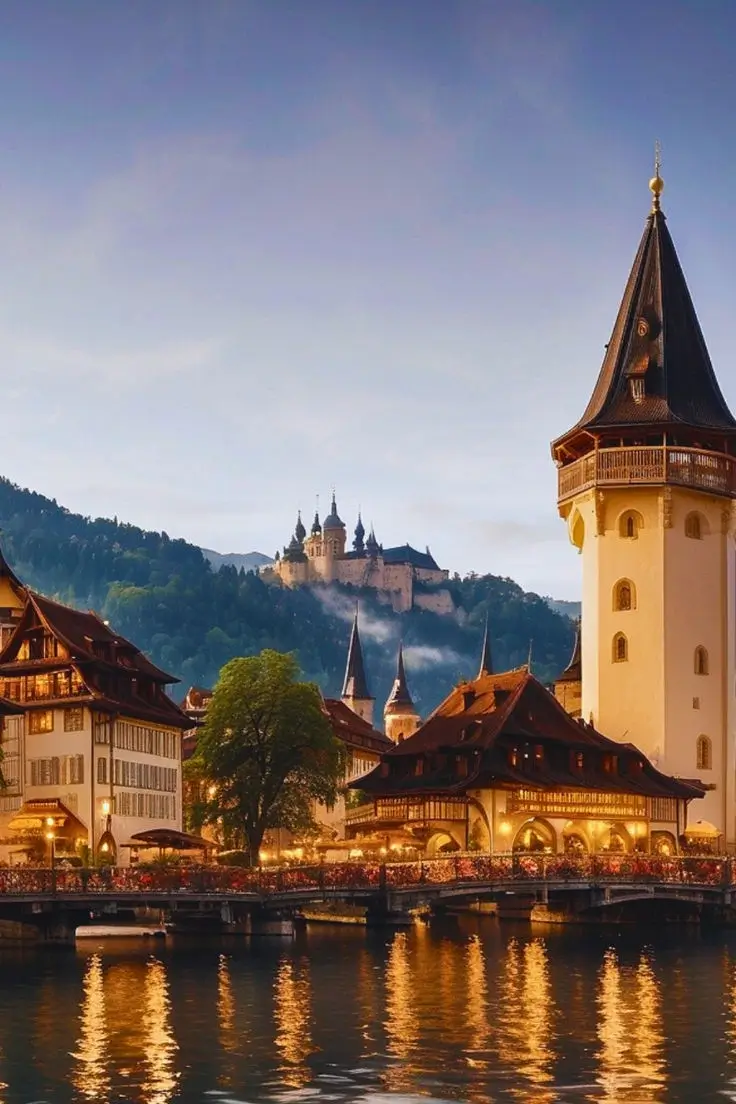
Lucerne is Switzerland's most romantic and visited city — a perfectly preserved medieval treasure set at the northern end of Lake Lucerne (Vierwaldstättersee), where the turquoise Reuss River meets a ring of snow-capped Alpine peaks. The city's defining landmark, the Kapellbrücke (Chapel Bridge, 1333), is Europe's oldest surviving covered wooden bridge: a 204-metre timber gallery stretching across the Reuss, anchored by the medieval Water Tower and decorated inside with a celebrated sequence of 17th-century paintings. A short walk away, the Lion Monument (Löwendenkmal) — a dying lion carved into a sandstone cliff in 1820 — remains one of the world's most moving sculptures. Rising above the city, Mount Pilatus (2,132 m) offers the ultimate Alpine panorama, reached via the world's steepest cogwheel railway from Alpnachstad or by aerial gondola from Kriens — the classic Golden Round Trip combining both routes is a Lucerne highlight not to be missed. On the lake, the white paddle steamers of the Lake Lucerne Navigation Company glide between historic resort hotels, with the Bürgenstock Resort rising dramatically on its cliff above the eastern shore offering some of the most extraordinary hotel views in Europe. The Swiss Museum of Transport (Verkehrshaus) is Switzerland's most visited museum, and the lakefront KKL Luzern — designed by Jean Nouvel and considered one of the finest concert halls in the world — hosts the legendary Lucerne Festival each August, drawing the world's greatest orchestras and conductors. For all its fame, Lucerne rewards those who linger: explore the painted house façades of the Old Town, the medieval Musegg Wall and its intact towers, and the covered Spreuerbrücke — older rival of the Kapellbrücke, hung with a remarkable cycle of Dance of Death paintings.
Frequently Asked Questions
Everything you need to know before visiting Lucerne, Switzerland
-
The best time to visit Lucerne is from May to October, when the weather is warm, Lake Lucerne is ideal for boat excursions, and all mountain railways to Pilatus and Rigi are fully operational. June and September offer warm weather with fewer crowds than the July–August peak. Winter brings an atmospheric Christmas market and ski day trips to Engelberg and Andermatt, though some boat services are reduced and mountain summits may be cloud-covered.
-
Lucerne's finest luxury hotels include Palace Hotel Luzern (five-star lakefront grandeur with private boat landing), Hotel Schweizerhof Luzern (legendary five-star on Schweizerhofquai since 1845, with panoramic lake and mountain views), Grand Hotel National Luzern (magnificent Belle Époque heritage landmark), Hotel Montana Luzern (romantic hilltop retreat), and the extraordinary Bürgenstock Resort Lake Lucerne — an ultra-luxury mountain resort perched 500 metres above the lake, with private funicular access, an Alpine spa, and an infinity pool with one of Switzerland's most jaw-dropping views.
-
Lucerne is internationally famous for the Kapellbrücke — Europe's oldest covered wooden bridge (1333) — and the Lion Monument (Löwendenkmal), which Mark Twain called "the most mournful and moving piece of stone in the world." It is also celebrated for the stunning Lake Lucerne (Vierwaldstättersee) encircled by Alpine peaks, Mount Pilatus (reached by the world's steepest cogwheel railway), the Swiss Museum of Transport (Switzerland's most visited museum), and the KKL Luzern concert hall (designed by Jean Nouvel), home of the world-renowned Lucerne Festival each August.
-
Lucerne is easily reached by direct train from Zurich Airport (ZRH) in approximately 1 hour, and from Zurich main station in just 50 minutes. From Geneva Airport (GVA), the journey takes approximately 3 hours via Bern or Zurich. Basel SBB to Lucerne takes approximately 1 hour. The train station is in the heart of the city, directly beside the lake and a 3-minute walk from the Kapellbrücke. The Switzerland Travel Pass covers the journey and provides free or discounted access to mountain railways and Lake Lucerne boat services.
-
Lucerne is expensive by European standards but slightly less so than Zurich or Geneva. A return trip to the summit of Mount Pilatus (cogwheel railway + aerial gondola) costs approximately CHF 72 per adult. A full-day Lake Lucerne boat pass costs approximately CHF 55. Mid-range hotels start from around CHF 180 per night; five-star properties from CHF 350–800+. Dining ranges from CHF 20 at a local bakery to CHF 150+ at fine dining restaurants. The Switzerland Travel Pass offers significant savings on trains, boats, and many mountain railways across the region.
-
The best day trips from Lucerne are: Mount Pilatus (boat to Alpnachstad + world's steepest cogwheel railway to 2,132 m — approx. 3 hrs round trip); Mount Rigi — the 'Queen of Mountains' (boat to Vitznau + Europe's first mountain railway, 1871); Engelberg and Titlis (1 hr by train — Klein Titlis glacier at 3,028 m); Bern (1.5 hrs by train — Switzerland's federal capital with UNESCO Old Town); Zurich (50 min by train — art, shopping, Lake Zurich); and a lake cruise through the historic Uri bay to Flüelen — one of the most beautiful boat journeys in the Alps.
-
The Kapellbrücke (Chapel Bridge) is a 204-metre covered wooden footbridge crossing the Reuss River in central Lucerne. Built in 1333, it is Europe's oldest surviving wooden covered bridge and the single most photographed landmark in Switzerland after the Matterhorn. The bridge is anchored at its midpoint by the octagonal Water Tower (Wasserturm), which has served as a treasury, archive, and prison. Inside the bridge, triangular paintings from the 1600s depict scenes from Lucerne's history — many restored after a fire in 1993. Crossing the Kapellbrücke at dawn, with mist rising from the Reuss and the Alps reflected in the still water, is one of the great experiences of European travel.