
Darjeeling Travel Guide
The Queen of Hills — where first-flush tea perfumes the morning air, Kangchenjunga rises through the mist at dawn, and the steam whistle of the UNESCO Toy Train echoes across 87 working tea estates. Our expert editors curate the finest luxury stays, cultural experiences, and insider secrets for visiting Darjeeling, West Bengal — updated for 2026.
Expert Darjeeling Guides
Himalayan Healing: Experience Ultimate Luxury Wellness in Darjeeling, the Queen of Hills
Discover Darjeeling's finest experiences — from Tiger Hill's legendary Kangchenjunga sunrise and the UNESCO Toy Train's spiral at Batasia Loop, to private tea estate walks, the colonial grandeur of the Windamere Hotel, and a first-flush tasting at Nathmul's legendary tea room.
Darjeeling at a Glance
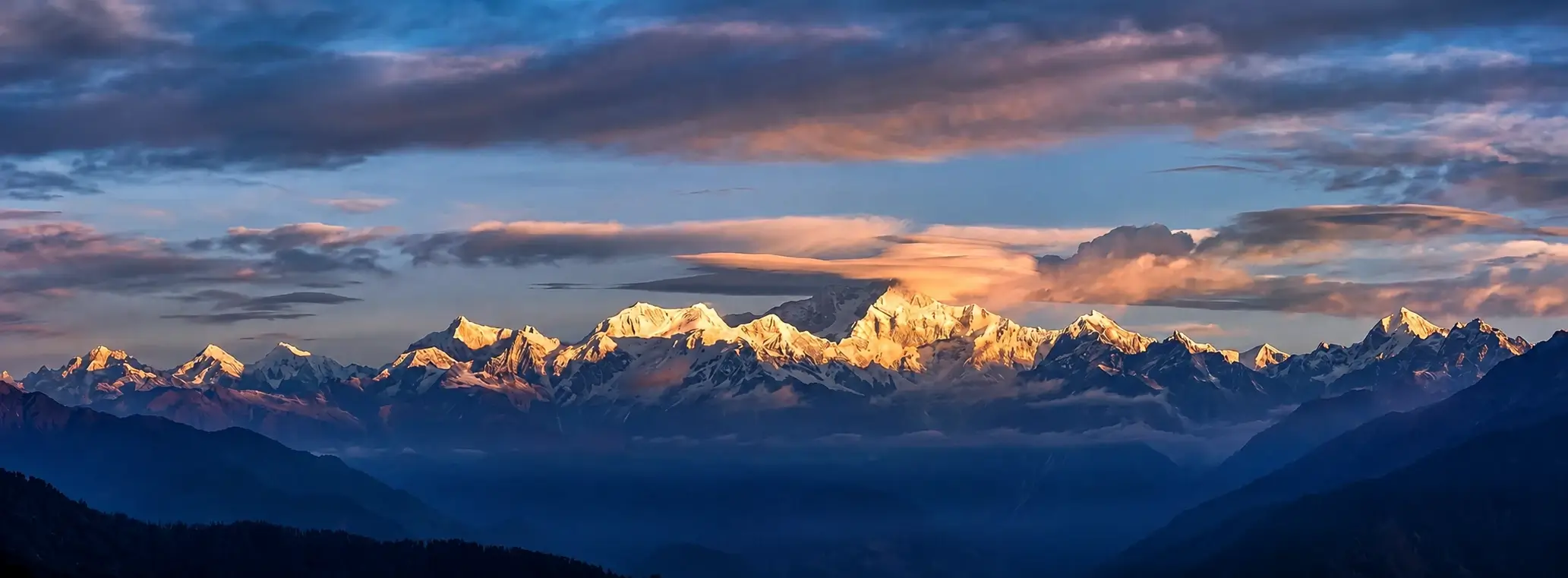
Darjeeling is India's most romantic hill station — the Queen of Hills, perched at 2,050 metres in the Himalayan foothills of West Bengal where the world's finest tea grows in terraced gardens that cascade down the misty slopes toward the Teesta valley far below. Its crown jewel is Kangchenjunga (8,586 m) — the world's third highest peak — which reveals itself at dawn above the cloud-line in a display of pink-gold light that has been drawing travellers to Tiger Hill since the British first built their summer capital here in the 1830s. The Darjeeling Himalayan Railway — the beloved Toy Train, a UNESCO World Heritage Site since 1999 — still climbs the mountain on its narrow 2-foot gauge track, looping back on itself at the spectacular Batasia Spiral before chugging on to Ghoom (2,258 m), the highest railway station in India. But Darjeeling's greatest gift to the world is its tea. The First Flush harvest — plucked each March and April from the upper elevations of estates like Castleton, Thurbo, and Makaibari — produces a pale, floral, muscatel tea that commands the highest prices at auction of any tea on earth. For luxury travellers, the definitive address is Glenburn Tea Estate, 30 km below town on the Rangeet River — a fully private working estate with four colonial bungalows, butler service, and guided walks through the plucking rows at harvest time. In town, the Windamere Hotel on Observatory Hill has changed almost nothing since 1939: open fires in the sitting room, afternoon teas on chinaware, and a hushed, faded grandeur that feels like the last act of a very beautiful dream.
Frequently Asked Questions
Everything you need to know before visiting Darjeeling — the Queen of Hills
-
The two best times to visit Darjeeling are October–November and March–May. October and November offer the clearest skies of the year — the monsoon has washed the air, and views of Kangchenjunga (8,586 m) are at their most dramatic, making Tiger Hill sunrises most reliable. March to May brings Darjeeling's famous rhododendron blooms across the hillsides, and the First Flush tea harvest begins in late March — the most prized harvest of the year. Avoid late June to September (heavy monsoon rains, landslides, poor visibility). December and January are cold but atmospheric, with possible snowfall and minimal crowds — perfect for guests seeking solitude at the heritage hotels.
-
Darjeeling's finest luxury stays: Glenburn Tea Estate (Rangeet River, 30 km from Darjeeling town) — the definitive luxury experience in the region, a fully private working tea estate with four restored colonial bungalows, butler service, garden-to-table dining, and guided estate walks; The Windamere Hotel (Observatory Hill, since 1939) — Darjeeling's most iconic heritage property with open fires, afternoon teas, and Victorian atmosphere; The Elgin, Darjeeling (1887) — a gracious Heritage Hotel with Victorian furniture and Himalayan views; Mayfair Darjeeling — the most comprehensively modern five-star in town with a spa and direct Kangchenjunga views; and for an immersive experience, Makaibari Tea Estate Bungalow — India's oldest biodynamic tea garden with private bungalow accommodation.
-
Darjeeling is world-famous for Darjeeling tea — widely considered the finest black tea in the world, produced in 87+ tea gardens at elevations up to 2,000 m, with a GI (Geographical Indication) tag. It is also celebrated for Kangchenjunga (8,586 m — world's third highest peak) visible from Tiger Hill and Observatory Hill; the Darjeeling Himalayan Railway (DHR), a UNESCO World Heritage narrow-gauge steam railway known as the Toy Train; extraordinary colonial-era heritage hotels including the Windamere and the Elgin; the Himalayan Mountaineering Institute founded by Tenzing Norgay; rhododendron-covered hillsides in spring; and its unique cultural identity blending Nepali, Tibetan, Lepcha, and Bengali traditions.
-
Darjeeling is reached by road from Bagdogra Airport (IXB), approximately 70 km away (2.5 to 3 hours by car). Bagdogra has direct flights from Kolkata (~45 min), Delhi (~2 hrs), and Mumbai. The nearest railway station is New Jalpaiguri (NJP), 3 hours by road. The iconic Darjeeling Himalayan Railway (Toy Train) connects NJP to Darjeeling in 7–8 hours — a UNESCO World Heritage journey through mountain scenery. Most luxury travellers pre-book a private transfer from Bagdogra or NJP with their hotel. From Kolkata, the Darjeeling Mail overnight train to NJP takes approximately 9 hours, followed by a mountain road transfer.
-
The Darjeeling Himalayan Railway (DHR), known as the Toy Train, is a narrow-gauge (2 ft / 610 mm) steam railway built between 1879 and 1881. It climbs 88 km from New Jalpaiguri (88 m) to Darjeeling (2,076 m) using loops and reverses, including the spectacular Batasia Loop — a full 360-degree spiral with an ornamental war memorial and panoramic Kangchenjunga views. In 1999, UNESCO designated the DHR a World Heritage Site — only the second railway in the world to receive this honour (after Austria's Semmering Railway). The steam joyride from Darjeeling to Ghoom (2,258 m — India's highest railway station) and back takes approximately 2 hours and is one of the most iconic heritage rail experiences in Asia.
-
Darjeeling tea holds a Geographical Indication (GI) tag — only tea grown in the designated Darjeeling district can legally be sold as Darjeeling tea. Produced in 87+ gardens at 600–2,000 m elevation, a unique combination of altitude, climate, soil, and Himalayan mist creates the tea's celebrated muscatel character — a distinctive grape-like flavour found nowhere else. There are four harvests: First Flush (March–April) is the most prized — pale, floral, and delicate, fetching the highest auction prices; Second Flush (May–June) produces the iconic muscatel; and Autumn Flush (October–November) offers full-bodied character. Single-estate teas from Makaibari, Castleton, Thurbo, and Glenburn are among the most expensive teas in the world.
-
Kangchenjunga (8,586 m), the world's third highest peak, is visible from Darjeeling on clear days — most reliably in October, November, and March–May. Tiger Hill (2,590 m) is the most famous viewpoint — renowned for its pre-dawn sunrise over the Himalayan range; on exceptionally clear mornings, Everest (8,849 m) itself appears as a distant triangle above the massif. Batasia Loop (on the Toy Train route) offers the most photogenic foreground for photography. Observatory Hill in the town centre has a panoramic view. For Tiger Hill sunrise, depart Darjeeling at 3:30–4:00 AM; luxury hotels arrange private dawn excursions with packed breakfasts. October and November have the highest probability of clear views.
-
Top day trips from Darjeeling: Kalimpong (1.5 hrs by road) — a market town and orchid cultivation centre with Buddhist monasteries and sweeping Himalayan views; Mirik Lake (2 hrs) — a peaceful reservoir surrounded by tea estates and pine forests, ideal for a serene afternoon; Tiger Hill Sunrise (30 min, predawn) — the most spectacular morning vista in the Eastern Himalayas, best arranged privately through your hotel; Ghoom Monastery via Batasia Loop (30 min Toy Train) — the oldest Buddhist gompa in Darjeeling (est. 1875) housing a 5-metre Maitreya Buddha; Happy Valley Tea Estate (10 min) — one of the largest estates open for guided tours and cupping sessions; and for a 2–3 day extension, Gangtok in Sikkim (3 hrs by road) — the capital of a former kingdom with extraordinary Himalayan views, Rumtek Monastery, and access to Tsomgo Lake.