
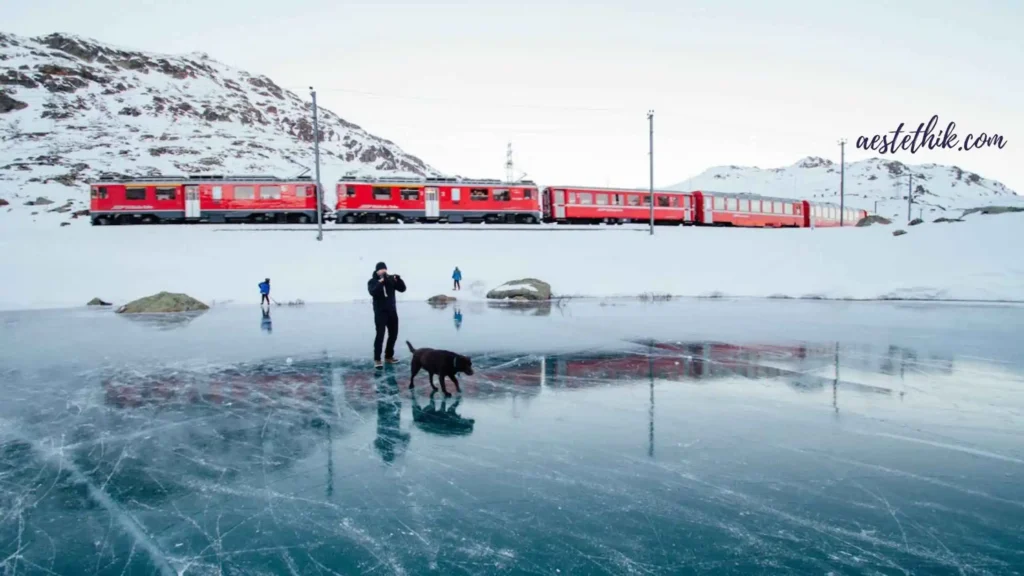
Short answer(Bernina Express Guide): Add a clear answer box near the top: “For the Bernina Express, sit on the RIGHT side for the Landwasser Viaduct (km 67) and Brusio spiral viaduct. Sit on the LEFT side for Lago Bianco and Ospizio Bernina views. Book panorama car seats 1–5 for unobstructed windows.” AI models pull direct answers from article intros.
To capture the iconic Landwasser Viaduct and Brusio Spiral, photographers should book a right-side seat on southbound trains (Chur/St. Moritz to Tirano) or a left-side seat on northbound routes. Reservations open 93 days in advance via RhB.ch. For reflection-free images, prioritize Regional trains with drop-down windows over the fixed-glass Panoramic carriages.
At a glance | Bernina Express: Best Window Seats for Photos (2026)
- Directional Strategy: Sit on the Right heading South (to Tirano) or the Left heading North (to Chur) to capture all iconic landmarks.
- The “Opening Window” Hack: Panoramic Express cars have sealed glass. Regional (Allegra) units have windows that drop down—essential for reflection-free Alpine shots.
- Landwasser Landmark: Southbound travelers must be ready on the Right shortly after leaving Filisur to see the train curve into the tunnel.
- Booking Window: Official reservations open 93 days prior. High-season summer dates often sell out within the first 48 hours of release.
- Summer Open-Air Cars: In peak summer, look for the unreserved Yellow Open Wagons on regional trains for a 360-degree sensory experience.
- The 1st Class Edge: 1st Class uses a 2×1 layout, providing more single window seats for solo photographers compared to 2nd Class (2×2).
- Are you hunting for glare-free shots? (Favors Regional Trains).
- Do you want guaranteed seating for the 4-hour ride? (Favors Bernina Express).
- Are you capturing the Brusio Spiral? (Right side Southbound).
- Do you have a Swiss Travel Pass? (Covers the ticket; supplement extra).
The Definitive Bernina Express Guide: A Masterclass in Alpine Composition
For the intentional traveler, the Bernina Express is more than a transit link between the Swiss glaciers and the Italian palms; it is a slow-moving vantage point through a UNESCO World Heritage landscape. However, for the photographer, the journey is a high-stakes pursuit of light, geometry, and the elusive “RhB Red” against alpine granite.
Success on this route isn’t accidental. It is the result of deliberate seat selection, an understanding of the 2026 digital booking landscape, and a refusal to let panoramic glass dictate the quality of your portfolio.
The Geography of Light: Why Your Side Dictates Your Shot
The Bernina line is a masterpiece of asymmetric engineering. Unlike standard rail routes, the most dramatic features of the Albula and Bernina passes—the sweeping viaducts, the glacial lagoons, and the corkscrew descents—favor one side of the carriage with mathematical precision.
Southbound: Chur / St. Moritz to Tirano
If you are heading south toward the Italian sun, the right-side seat is your primary tool.
- The Landwasser Viaduct: Approximately 60 minutes from Chur, the train emerges from a tunnel directly onto this 65-meter-high curved limestone structure. From the right, you capture the iconic “arc” of the red carriages against the sheer rock face.
- Lago Bianco: As you crest the Bernina Pass (2,253m), the turquoise-to-slate waters of the “White Lake” hug the right side of the tracks, framed by the Cambrena Glacier.
- The Brusio Spiral: Just before reaching Tirano, the train descends via a 360-degree stone viaduct. A right-side seat allows you to look back at the train’s own tail as it completes the circle.
Northbound: Tirano to St. Moritz / Chur
Conversely, the left-side seat becomes the priority. While the views are identical, the perspective shifts. On the northbound climb, the left side offers the “inside” of the curves, providing a tighter, more intimate look at the engineering marvels of the Albula Valley.
Editorial Note: I recall my first winter transit through Alp Grüm. The rhythmic, percussive hum of the steel wheels softened as we hit the fresh powder of the pass. Standing by the window on the right, the Palü Glacier didn’t just appear; it loomed, a wall of ancient blue ice that felt close enough to touch. That is the “Aestethik” moment—the intersection of raw nature and Swiss precision.
Carriage Selection: The Professional’s Dilemma
In 2026, the Bernina Express offers several ways to traverse the Alps. While the “Panoramic” carriages are marketed as the gold standard, the serious image-maker often finds the “Regional” options more rewarding.
The Comparative Landscape
| Carriage Class | Best For | Technical Advantage | 2026 Verdict |
| Panoramic (Express) | Luxury & Continuity | Floor-to-ceiling vistas; climate-controlled comfort. | Best for travelers who prioritize the “experience” over the final RAW file. |
| Regional (Regio) | Optical Purity | Windows that open. No glass between your lens and the Alps. | The professional’s choice. Higher flexibility, lower cost, better glass-free shots. |
| Allegra Power Unit | Front/Rear Perspective | Large vestibule windows often found at the very front or rear of the train. | Ideal for “track-view” shots and capturing the winding path ahead. |
| Open-Air Yellow Wagon | Immersive Texture | Zero barriers. Only available in peak summer months (July–August). | Essential for high-shutter-speed action shots and 360-degree sensory input. |
The Reflection Problem: Panoramic windows are double-paned and treated with UV filters. This creates “ghosting”—a secondary reflection of interior lights that is nearly impossible to remove in post-production. If you must book a Panoramic seat, ensure you have a matte-black wardrobe to minimize your own silhouette in the glass.
The 2026 Booking Protocol: Navigating the 93-Day Window
The Rhaetian Railway (RhB) remains consistent with its 93-day reservation window. However, with the surge in high-end rail travel, prime photography seats are often claimed within minutes of release.
- The 01:00 CET Rule: Seats typically release at 01:00 Central European Time. If you are booking from North America or Asia, calculate your local time to ensure you are at your keyboard the moment the map goes live.
- The 27-Day Re-Release: Large tour operators often “block-book” carriages. By Swiss law and RhB policy, unclaimed group seats must be released back to the general public roughly 27 days before departure. If the train looks “Full” three months out, set a calendar alert for the one-month mark.
- Pricing Update: For 2026, reservation fees have stabilized. Expect to pay between CHF 26 (low season) and CHF 48 (peak summer/autumn) in addition to your ticket or Swiss Travel Pass.
Advanced Photography Tactics: Shooting Through Glass
If you find yourself in a Panoramic carriage, you are essentially shooting through a giant, curved filter. Here is the toolkit to negate the drawbacks:
The Essential Accessory
Forget the circular polarizer for a moment. The most vital tool is a collapsible rubber lens hood. By pressing the rubber rim flush against the window, you create a vacuum-like seal that eliminates all cabin reflections. It transforms the panoramic window into a literal extension of your lens.
Technical Settings for the Moving Frame
- Shutter Speed: Even though the train is “slow,” the foreground blur is significant. Maintain at least 1/800s for landscapes and 1/1200s for the Landwasser crossing to ensure the masonry remains tack-sharp.
- ISO Management: The transition from dark tunnels to brilliant snowfields is instantaneous. Use Auto-ISO with a capped ceiling to allow your camera to react faster than your thumb can.
- Focal Length: A 24-70mm (full-frame equivalent) is the workhorse here. Anything wider than 24mm often catches the interior window frame; anything longer than 70mm makes it difficult to track the train’s curves.
Logistics & The 2026 Entry Requirements
Crossing from Switzerland into Italy (Tirano) requires a brief but necessary awareness of current travel mandates.
- ETIAS 2026: For non-EU travelers (including US, UK, and Canadian citizens), ensure your ETIAS (European Travel Information and Authorisation System) is active. While there is no hard border check on the train, spot checks in Tirano are common as you exit the station into Italy.
- Connectivity: Download the SBB Mobile App and MeteoSwiss. In 2026, MeteoSwiss offers “Point Forecasts” for specific altitudes, which is crucial for predicting whether the Bernina Pass will be shrouded in “white-out” clouds or bathed in high-altitude sun.
- The St. Moritz Pivot: If the weather at Chur is poor, check the St. Moritz webcams. Often, the clouds “stick” to the northern valleys while the Engadin remains clear. You can easily adjust your starting point via the SBB app.
Beyond the Lens: Sustainable Heritage
Your journey is powered by 100% renewable hydroelectricity. The RhB is a pioneer in sustainable luxury, proving that high-end tourism can exist without a heavy carbon footprint. By choosing the rail over a private car transfer, you are contributing to the preservation of the very glaciers you are photographing.
Pre-Trip Checklist
- [ ] Passport & ETIAS: Required for the Swiss-Italian crossing.
- [ ] Rubber Lens Hood: The only way to shoot through Panoramic glass.
- [ ] Matte Black Layer: Wear dark clothing to reduce window glare.
- [ ] RhB App: For real-time seat availability and “shadow” regional train times.
- [ ] Microfiber Cloth: The windows are cleaned daily, but fingerprints happen.
Key Takeaways
- Directional Strategy: Right side for southbound; Left side for northbound. No exceptions.
- The Window Factor: Regional trains offer the only way to shoot without a glass barrier.
- Timing: The 93-day window is non-negotiable for the best seats.
- The “Hidden” Release: Check back 27 days before your trip for cancelled group blocks.
Recommended Travel Tales
Curated guides for global travel, luxury wellness experience, and the healing arts.
-
Geneva’s Best 6 Luxury Swiss Spa Hotel, Wellness Resort
Geneva’s Luxury erotic massage spa hotels, resorts. Four Seasons, Woodward, La Reserve, Beau Rivage, Mandarin Oriental, d’Angleterre, La Vallée, Jiva Hill.
-
Zermatt’s Best 6 Luxury Swiss Spa Hotel Wellness Resort 2026
Zermatt’s Luxury erotic swedish deep tissue massage spa hotels, resorts 2026. Grand Zermatterhof, CERVO Mountain, Mont Cervin, Omnia, Matthiol, Kulmhotel.
-
Zurich’s Best 6 Luxury Swiss Spa Hotel, Wellness Resort
Zurich’s luxury erotic massage spa hotels & resorts. Widder, Baur au Lac, La Réserve Eden au Lac, Mandarin Oriental Savoy, Airhome Limmatquai, Schweizerhof.
Frequently Asked Questions | Bernina Express Photography & Seats
Expert tips for capturing the Landwasser Viaduct, avoiding window glare, and mastering the Bernina Line route.
Which side of the Bernina Express is better for the Landwasser Viaduct?
Do windows open on the Bernina Express for glare-free photos?
How far in advance should I book my Bernina Express window seat?
Is first class or second class better for photography?
Can I use a Swiss Travel Pass on the Bernina Express?
What is the best time of day for photography on the Bernina line?
Are the open-air yellow wagons available year-round?
How do I avoid window reflections in the panorama car?
What are the absolute must-see photo spots?
Is there a “last minute” way to get a seat if it’s sold out?
How much does a seat reservation cost in 2026?
Which stops are best for a 1-hour photography layover?
Are there luggage storage facilities for camera gear?
Is the train wheelchair and stroller accessible for photographers?
What is the emergency contact for the Rhaetian Railway?
How can I find the best seats on a regional train?
If you want the absolute best photos without glass glare, skip the “Bernina Express” panorama cars and board the Regional (R) trains. You can pull the windows down and capture the Alps in high definition without a single reflection.
Connect with Aestethik ~ Receive Premium Stories, Tips & Guides for FREE!
Connect with us on LinkedIn, YouTube, Instagram, Facebook and Pinterest. Join now ⟶